
How New Websites Get Traffic from AI Search

Why AI Search Just Rewrote the Rules for Getting Your First Users
A field guide to Generative Engine Optimization (GEO) for solo founders and indie hackers
The Problem Nobody Warned You About
Building a website or a SaaS product is easier than it has ever been. With AI coding assistants, a single founder can ship a working product in a weekend.
But almost every indie site hits the same wall: traffic.
Plenty of solo founders build a genuinely good product, launch a clean landing page, and then quietly die on the vine — not from lack of effort, but from not knowing where to point that effort. SEO grinds on for six months with nothing to show. Ad spend burns through the budget. Social posts get three likes and vanish.
Before fixing any of that, it helps to understand the deeper problem: the rules of the game changed while most people weren't watching.
A quick, honest plug before we go further: if you want to know whether AI systems can actually see your site right now, search Cyberbard. Cyberbard Auto Test is a free, one-click self-check that tells you whether ChatGPT, Perplexity, and other AI crawlers can read and understand your site — and exactly what's blocking them. No signup friction, just a report.
Search Just Split Into Two Roads
A few years ago, the traffic path was a clean, single lane: a user searches on Google → sees a list of blue links → clicks through. Your whole job was ranking in the top three.
Now there's a second lane running in parallel.
Users ask questions in Perplexity, ChatGPT, or Google's AI Overview — and instead of a list of links, they get a synthesized answer written by the AI, with a handful of citations tucked to the side. Most people take the answer and never open a single source.
The numbers are not subtle
| Metric | Value | Source |
|---|---|---|
| Users who click through an AI Overview citation | 1% | Pew Research Center, Jul 2025 |
| Drop in #1 organic CTR when an AI Overview appears | -58% | Ahrefs, 300K keywords analyzed |
| Search queries now covered by Google AI Overview | ~25–60% | Industry aggregates, 2025–2026 |
| Zero-click search rate, one year after AI Overview launch | 56% → 69% | Similarweb tracking study |
This isn't a minor fluctuation — it's a structural shift in where clicks go.
The damage is already showing up in traffic numbers
| Metric | Value |
|---|---|
| Zero-click rate for Google AI Mode searches (2025–2026) | highest of any surface |
| Zero-click rate on mobile searches | 77.2% |
| Top-ranked organic CTR drop when AI Overview appears | -34.5% |
| Organic news traffic lost, Jul 2024 → May 2025 | 600M+ monthly visits |
| Overall zero-click rate, May 2025 (up from 56% a year prior) | 69% |
Two roads, not a replacement. Both exist at once, but they're optimized completely differently:
- Traditional SEO — a ranking competition. Everyone is in the same list; the user decides who to click.
- GEO (Generative Engine Optimization) — a citation competition. The AI is assembling an answer, and the question is whether your content made the cut and got named as a source.
Think of it this way: SEO is a footrace for 1st through 3rd place. GEO is more like being chosen by an editor — the AI is writing a roundup article, and your content either gets included or it doesn't.
A solo founder now has to be findable on both roads at once.
What Actually Makes an AI Engine Cite You
Once you understand the mechanism, the priorities become obvious.
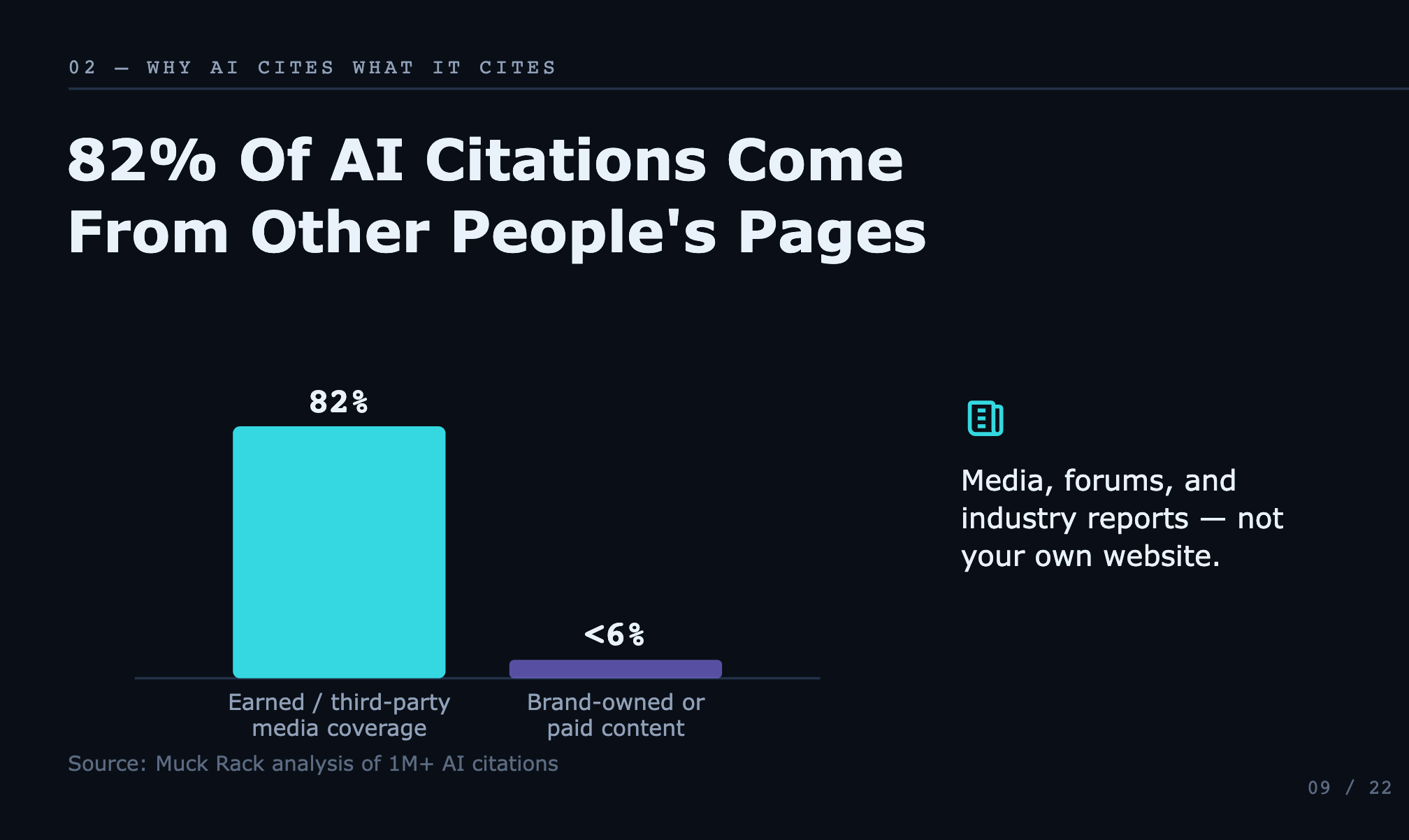
The core finding, stated plainly: AI engines overwhelmingly cite what other people say about you — not what you say about yourself.
Muck Rack analyzed over one million AI citations and found that 82% come from "earned media" — third-party press, forums, and industry reporting — while less than 6% come from brand-owned websites or paid content.
Where AI citations actually come from
| Source type | Share of citations |
|---|---|
| Earned media (press, forums, third-party sites) | 82% |
| Owned media (brand website, blog) | 12% |
| Paid / other | 6% |
A second data point drives the same conclusion home even harder. Ahrefs studied 75,000 brands and found:
| Off-site signal | Correlation with AI visibility |
|---|---|
| Brand mentions (being talked about elsewhere) | 0.664 |
| YouTube mentions | ~0.65 (comparable to brand mentions) |
| Branded anchor text | moderate |
| Branded search volume | moderate |
| Backlinks (the classic SEO metric) | 0.218 |
Brand mentions matter roughly 3x more than backlinks — the metric an entire SEO industry has spent two decades optimizing for.
One more counterintuitive number: 83% of Google AI Overview citations come from pages that don't even rank in the top 10 of organic search. Separately, ConvertMate found that only 6.82% of ChatGPT's citations overlap with a page's Google top-10 ranking. Being great at SEO does not automatically make you AI-citable.
The takeaway: AI systems judge credibility by how much of the internet is talking about you — not by how polished your own homepage copy is. The real work of GEO isn't a technical checklist. It's getting other people, on other sites, to mention you.
This is exactly the gap Cyberbard's Auto Test was built to surface — it checks whether your site gives AI crawlers enough to work with in the first place, before external mentions even enter the picture.
What You Can Still Control On-Page
External citations matter most, but on-page content quality still moves the needle — and it's measurable.
Princeton, Georgia Tech, and IIT Delhi ran the only peer-reviewed GEO study to date (KDD 2024), testing 10,000 queries across 10 search engines. Their findings:
| Content tactic | Effect on AI visibility |
|---|---|
| Adding specific data and statistics | +41% |
| Citing external sources (lower-ranked pages especially) | up to +115% |
| Adding quotations (e.g., expert statements) | +28% |
| Simply writing more words | no measurable effect |
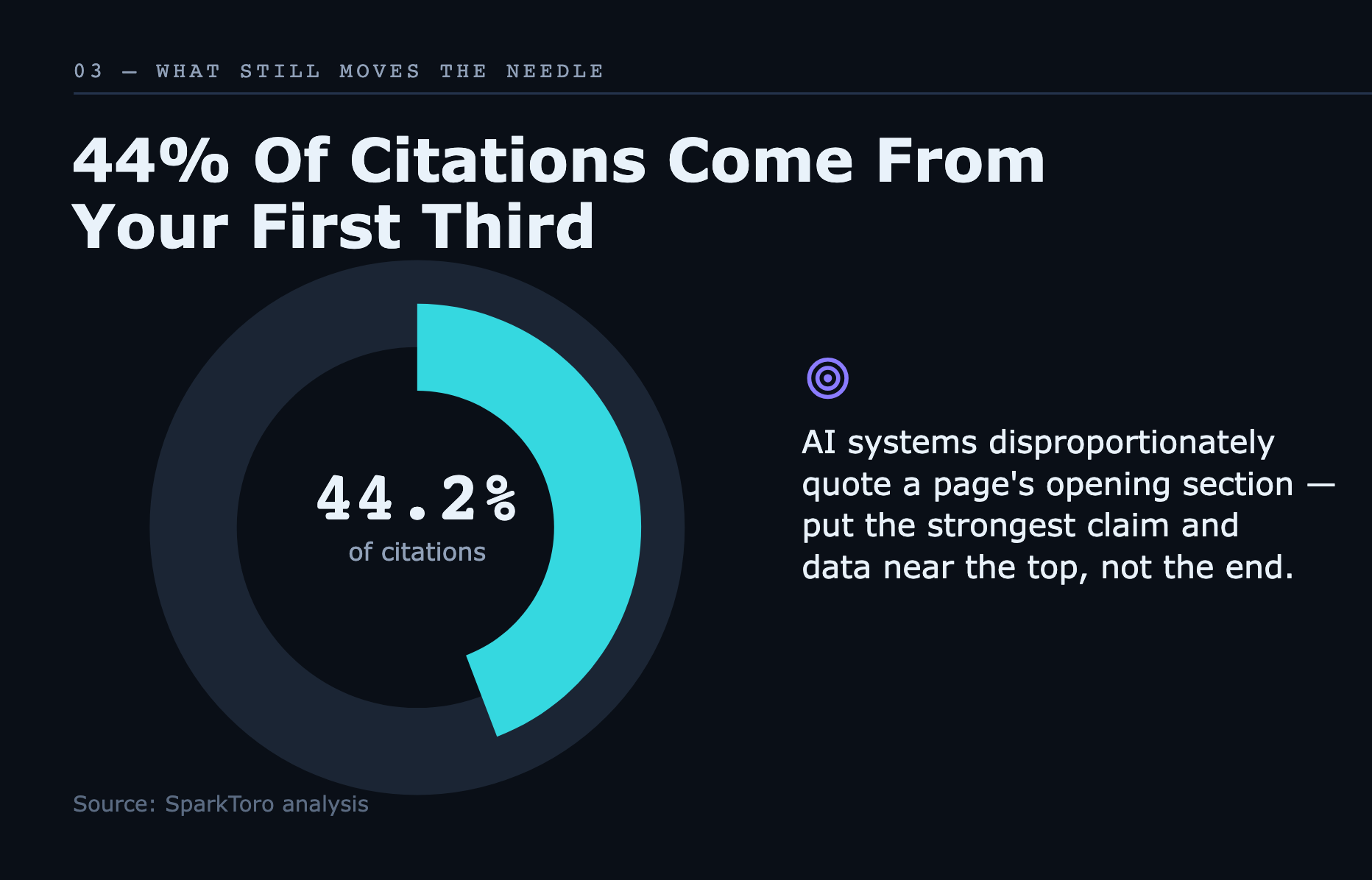
SparkToro's analysis adds one more critical detail: 44.2% of AI citations pull from the first 30% of a page — the opening section. Your strongest data and clearest claims belong at the top, not buried in paragraph twelve.
The GEO Flywheel: Six Moving Parts
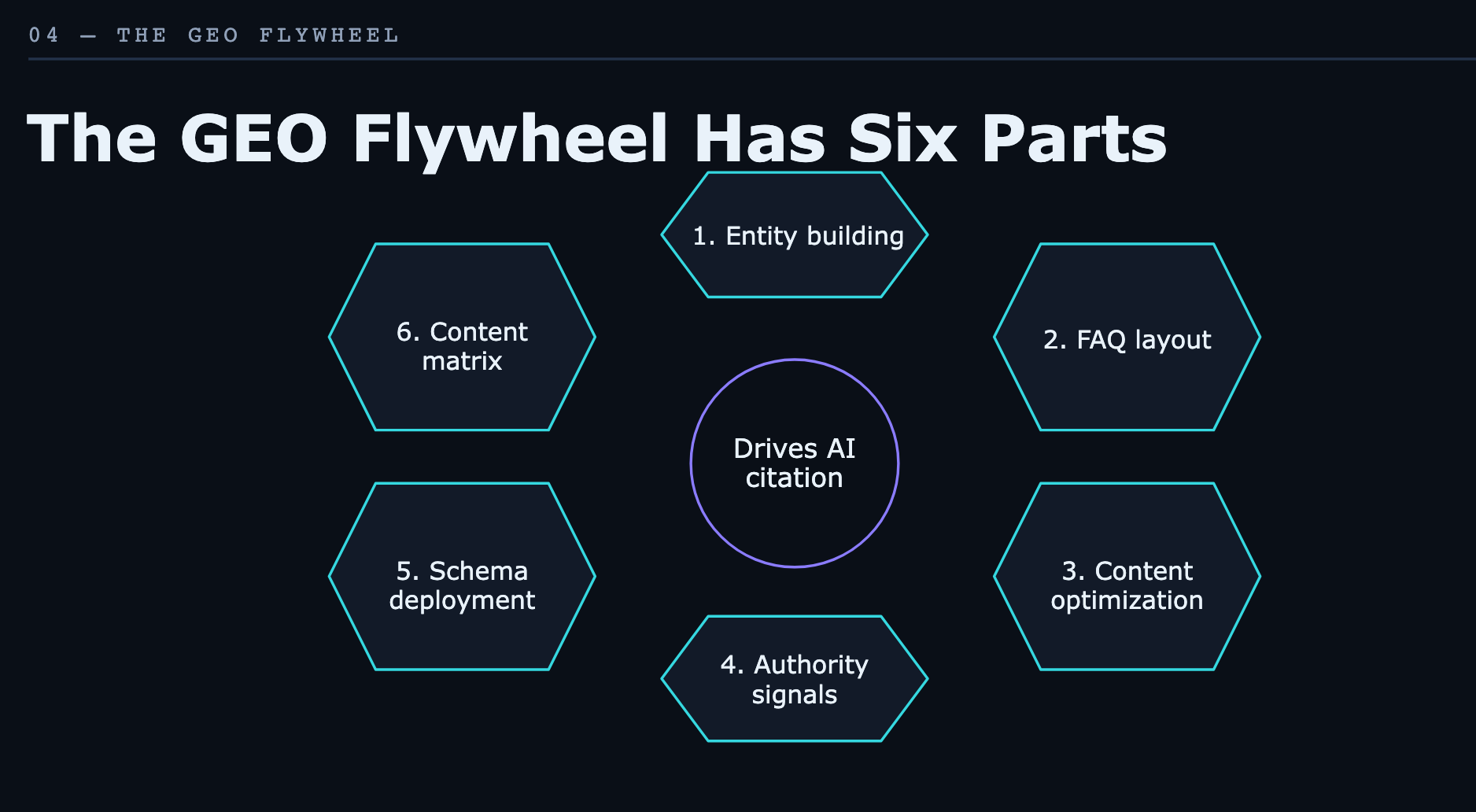
A complete GEO system has six components. They reinforce each other in a loop rather than working in isolation.
| # | Component | What it does |
|---|---|---|
| 1 | Entity setup | JSON-LD structured data tells AI "who you are, what you do, who you serve." This is the entry point for AI's understanding of your identity — skip it and everything downstream works at half efficiency. |
| 2 | FAQ layout | Cover the real questions users ask. FAQ-formatted content is among the highest-citation content types; FAQ sections are cited notably more often than plain paragraphs. |
| 3 | Content optimization | Write in natural language with concrete numbers. AI prefers directly quotable sentences over vague marketing language. |
| 4 | Authority signals | Customer case studies, industry data, real usage feedback. Content with specific numbers is cited 2.8x more often than content without them (ConvertMate, 2026). |
| 5 | Schema deployment | Go beyond Article — add Organization, FAQPage, and BreadcrumbList. 61% of AI-cited pages carry schema markup (Foundation Marketing, 2026). |
| 6 | Content matrix | One pillar page linked to 5–10 subtopic pages. AI treats a well-linked content cluster as a single knowledge node — far easier to cite wholesale than scattered, disconnected posts. |
Some of these are one-time setup tasks; others require ongoing investment. A solo founder can't do all six in parallel — prioritization matters.
Where Cyberbard fits in: Auto Test scores your site across 50+ crawler-accessibility and site-quality checks, then hands you a prioritized fix list — so instead of guessing which of these six levers to pull first, you get a ranked answer specific to your site.
A Priority Framework for a One-Person Team
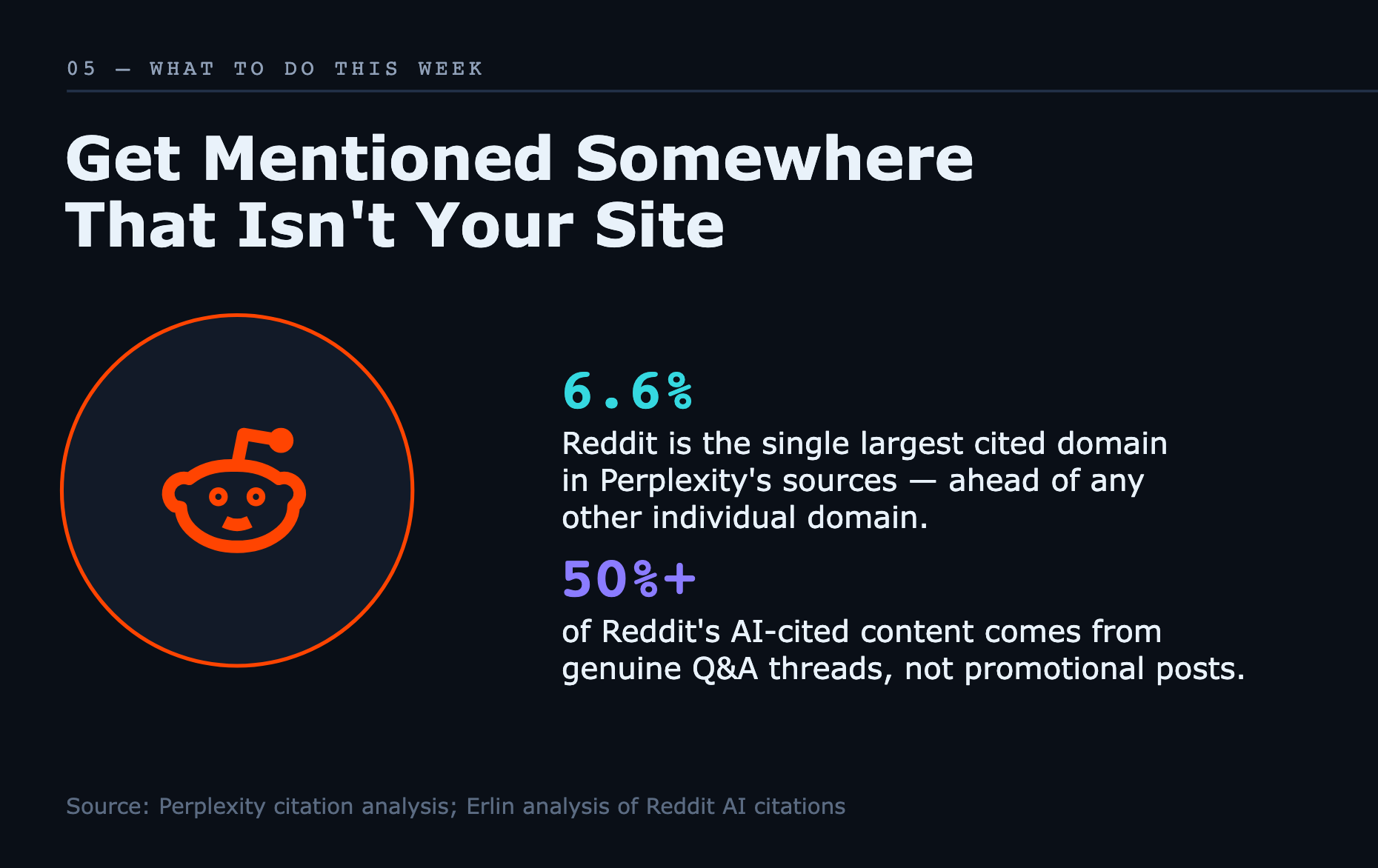
Ranked by return on effort. Three things to do now, three things to ignore for now.
Do these three, in order
| Priority | Action | Time investment | Why it matters |
|---|---|---|---|
| 1 | Tell AI who you are — add Organization JSON-LD to your homepage in plain language: who you are, what problem you solve, who you serve | ~15 minutes, one-time | This is the foundation AI uses to build any understanding of you. Skip it and everything else is built on sand. |
| 2 | Cover real questions with FAQ schema — add FAQ markup to product and content pages, addressing what users actually search for | ~1–2 hours per page | Princeton's research found FAQ format the most reliable trigger for AI citation — and it also boosts traditional Google Featured Snippets. One investment, two payoffs. |
| 3 | Find one reliable external exposure channel | Ongoing | The most important and most underrated step. External mentions move AI visibility roughly 3x more than on-page optimization (Ahrefs). Reddit is currently the lowest-barrier, highest-leverage channel — it's the #1 cited domain in Perplexity's sources at 6.6%, well ahead of any single competitor. Reddit Q&A threads alone account for over half of Reddit's AI-cited content. |
Three things you can safely ignore, for now
| Skip it | Why |
|---|---|
llms.txt file | Google has explicitly said it isn't required; effectiveness on other platforms remains unproven |
| Paid schema-generation services | Hand-writing your own JSON-LD is sufficient — no tool required |
| Checking your AI citations daily | Citation data is noisy short-term; a weekly check is enough |
Where to Start: A 15-Minute Reality Check
If none of this has happened on your site yet, the honest first move isn't writing more content — it's finding out what's currently invisible to AI crawlers.
Cyberbard Auto Test does exactly that, for free:
| Cyberbard Auto Test | |
|---|---|
| ✅ One-click, no-cost check | Run it in minutes, no developer needed |
| ✅ 50+ crawler-accessibility & site-quality checks | Covers structured data, robots rules, page structure, and more |
| ✅ GPTBot / ClaudeBot / PerplexityBot reachability testing | See exactly which AI crawlers can — and can't — reach your pages |
| ✅ Scored report + prioritized fix list | Know what to fix first, not just that something's wrong |
| ✅ Step-by-step remediation guide | No developer required to act on the findings |
Sample check — Organization schema, the exact starting point from Priority #1 above:
This is precisely the kind of block Cyberbard's Auto Test looks for — and flags — when it's missing.
Closing Thought
The traffic playbook every indie founder learned — rank in Google, drive clicks, convert — hasn't disappeared. It's just no longer the whole game. A second, parallel game is being played by AI engines that decide who gets cited, and that game runs on different rules: earned mentions over backlinks, structured clarity over word count, and being embedded in the wider internet conversation over polishing your own homepage copy.
You don't need to solve all six flywheel components this week. Start with the 15-minute one, check where you stand with Cyberbard Auto Test, and work down the priority list from there.