
How to Get AI to Recommend Your Product

The Complete Beginner's Guide to GEO: How to Get AI to Recommend Your Product
Before you start: Want to know if AI can even see your site right now? Search for Cyberbard and run its free Auto Test — it checks whether ChatGPT, Perplexity, and other AI systems can actually read and understand your site, and shows you exactly what's blocking them. No signup friction, results in minutes.
Preface
You may have already noticed that many of your users are no longer searching for "keywords" in traditional search engines to find your website and services. Instead, they are asking questions directly in various AI tools, where the AI provides solutions straight away, along with a few recommended websites—complete with a direct breakdown of each site's pros and cons regarding the user's specific problem.
Obviously, traffic from traditional SEO (a separate topic altogether, which we'll assume you're already familiar with) is being diverted, and this trend will only accelerate. As a result, some people came up with the concept of GEO (Generative Engine Optimization) to help those who need traffic understand how to get organic traffic in the age of artificial intelligence.
You might be worried about an endless stream of new knowledge to learn—don't worry! This article uses the simplest possible language to explain what someone who knows absolutely nothing about GEO should do to get traffic for their website. Of course, if you don't care about the details, you can also directly use our tool, Cyberbard. You only need to enter your website's URL, and it will give you detailed reports telling you what to do every week and every month (it even provides targeted code solutions directly) to boost your website's visibility in AI search.
The field of GEO is still very new, and many views are constantly evolving—what's true today might be outdated tomorrow. In the future, we will collect and publish the latest GEO articles on our Blog. If you spot any mistakes, feel free to click the feedback button at the bottom right corner of the website to contact us anytime.
To help you get the most out of this article, we've also prepared video and PPT links, which you are free to check out. If you prefer reading text, you can simply skip them.
PPT
📎 The Complete Beginner's Guide to GEO.pptx
Alright, let's jump straight into the main text.
Introduction: Search Is Being Replaced by "Ask"
More and more people no longer type a query into a search box — they just ask ChatGPT, Perplexity, or another AI assistant directly.
If your product never shows up in the AI's answer, it doesn't matter how good it actually is. In this new entry point to the internet, you simply don't exist.
This guide walks through, end to end, how to get AI to recommend your product.
Chapter 1 — What GEO Is, and Why AI Products Need It
1.1 What Is GEO?
GEO (Generative Engine Optimization) is the practice of making your content visible to AI, understandable by AI, citable by AI — and ultimately recommended by AI.
The easiest way to understand it is by comparing it to SEO (Search Engine Optimization):
| Goal | |
|---|---|
| SEO | Rank near the top of a search results page — like grabbing a good spot on a shelf so users notice you |
| GEO | Get the AI to say your name out loud when it answers a question — like having a knowledgeable salesperson actively recommend you to the customer |
Example: A user asks an AI, "What are some good AI meeting-note tools?" If the AI's answer lists Cyberbard by name and explains what makes it good, GEO is working. The user never searched further, never clicked a link — the AI just handed them the answer.
You may also have heard the terms AEO or AISEO — they describe the same idea. GEO is simply the most widely used term today.
1.2 The Traffic Entry Point Is Shifting
Why does this suddenly matter?
Because how people get information has changed. You used to type keywords into a search box and sift through a page of links yourself. Now, more and more people just ask an AI, and the AI hands back a ready-made answer.
This has produced a new phenomenon: zero-click search.
You used to search "tomorrow's weather" and click into a weather site. Now you ask an AI, and it just tells you: "Sunny, 25°C tomorrow." You read it and you're done — no click, no visit.
For any product, this means the traffic logic has fundamentally changed. It used to be about search ranking. Now it's about whether the AI cites you at all. Whoever the AI picks becomes the authority in the user's eyes.
1.3 Why This Matters Even More for AI Products
GEO benefits every business, but it's an especially large opportunity if you're building an AI product — particularly one targeting a global, English-speaking market.
First, global AI systems can freely crawl the open web. ChatGPT, Perplexity, and Google's AI Overviews crawl the entire internet, including your product's own website. This is very different from fragmented, siloed ecosystems where AI struggles to reach smaller sites.
Second, global AI systems trust well-built websites. A product website with solid, well-structured content is, by itself, a highly trusted source of information for AI. In other words, simply building a good website is the most direct and efficient form of GEO. Your own site is the main battlefield — which is exactly why every product targeting a global audience needs a strong independent website.
Chapter 2 — Is GEO Right for Your Product?
GEO is a major trend, but it's not worth the investment for every business. Before you start, run this check first.
2.1 What Kind of Business Benefits Most
The core question: before spending money, does the user research and compare first?
The more homework a purchase requires, the higher the return on GEO:
| Business type | Typical buying behavior | GEO payoff |
|---|---|---|
| High-consideration purchase (SaaS tools, B2B software, enterprise services) | User compares multiple options, reads reviews, asks around before buying | High — exactly where AI answers replace manual research |
| Impulse / low-cost purchase (snacks, small accessories, one-off consumables) | User decides on the spot, rarely researches | Low — GEO effort rarely changes the outcome |
| Trust-sensitive purchase (healthcare, finance, legal, big-ticket items) | User researches extensively and cross-checks credibility | Very high — AI's answer often is the trust signal |
Cyberbard falls squarely into the first category — it's a SaaS tool, and buyers almost always compare options before committing. That's GEO's sweet spot.
2.2 Two Prerequisites
You can't just decide to "do GEO" — AI crawlers are picky, and you need two basic things in place first.
- You need actual content. If your site is nothing but slogans, AI has nothing to extract.
- You need a real footprint on the web. If the only place claiming you're great is your own website, AI won't believe it.
Here's a common misconception: "If I just spend enough on ads, AI will get to know me." That logic works on humans. It does not work on AI. You have to leave indexable data across the web.
What counts as indexable data? Genuine third-party discussion. A review that mentions your product's pros and cons — that's indexable data. You calling yourself "the best in the universe" on your own site — that's just advertising noise, and AI discounts it.
If your brand has nothing online except ads and zero independent discussion, AI will conclude you don't exist. Worse — when a user asks whether you're trustworthy and AI can't find enough information, it may simply hallucinate, or even attribute someone else's negative reputation to you. So even without an aggressive marketing push, you need a baseline of real, findable information — enough for AI to know who you are.
Chapter 3 — How AI Actually Decides Who to Recommend
AI has no feelings. Who it recommends is the output of a fully mechanical, decomposable process. Understand this process, and you understand the core logic of GEO.
3.1 Two Steps: Retrieval and Generation
Most AI search today runs on RAG (Retrieval-Augmented Generation), which works in two steps:
- Retrieval — the moment you ask a question, the AI runs a search across the web it's connected to and instantly pulls a batch of relevant content: news articles, your product site, a forum thread.
- Generation — the AI reads what it retrieved, extracts the core facts, and rewrites them in its own words to produce the final answer.
The critical implication: if your content is never retrieved in step one, or is too disorganized to be extracted in step two, your brand can never appear in the final answer. So doing GEO well means reverse-engineering exactly how AI retrieves and extracts content — and writing accordingly.
3.2 The Three-Layer Filter AI Applies to Content
Out of millions of pages, how does AI end up choosing yours? Think of it as a three-stage funnel.
| Layer | Question it answers | AI favors | AI rejects |
|---|---|---|---|
| 1. Findable (crawlability) | Can AI even reach you? | High-authority sources, fast-loading pages, open crawler access | Sites that block AI crawlers, slow or broken pages |
| 2. Understandable (comprehension) | Can AI make sense of what it found? | Clear definitions, explicit lists, quantified specs | Emotional marketing copy, rambling logic, adjective-only ad language |
| 3. Trustworthy (credibility) | Should AI believe and repeat it? | Claims confirmed across multiple independent sources (cross-verification) | Single-source, unverifiable, or self-only claims |
The key concept behind Layer 3 is cross-verification: a single source carries low weight, but if your site, an independent review, and a news article all say the same thing, AI treats it as established fact.
3.3 The GEO Formula
The mechanism above boils down to one memorable formula:
GEO = SEO (get AI to find you) + RAG (get AI to want to cite you)
Broken into an operational form:
High recommendation rate = Authoritative reach (findable) + Structured content (understandable) + Data-backed credibility (trustworthy)
Chapter 4 — How to Write Content AI Actually Wants to Cite
AI has no sense of literary style. To AI, there's no such thing as "elegant" or "boring" writing — only "well-structured" or "logically messy." When AI reads content, it's essentially solving a fill-in-the-blank problem.
So there's really only one golden rule for GEO writing: write like an instruction manual, not an essay.
4.1 The General Principle: Lead With the Conclusion
Traditional writing builds up gradually and saves the key point for the end — a disaster for AI, which gives up if it can't find the point halfway through.
For GEO, every paragraph must open with its conclusion. Prefer short sentences over long ones, prefer separate paragraphs over run-ons, prefer numbered lists over prose. The goal: AI should be able to scan a paragraph once and extract exactly what it needs.
4.2 Four Content Templates That Get Cited
These four formats are the ones AI most reliably extracts and reuses. Combine several of them within the same article.
Template 1 — Definition (own the "what is it" answer)
AI loves this sentence structure when answering "what is X" questions.
Formula: [Brand/Product] is [category] + [core differentiator] + [founding date/track record]
Example: Cyberbard is a free AI-visibility testing tool for websites. Its core feature is an instant Auto Test that checks whether ChatGPT, Perplexity, Claude, and other AI crawlers can actually read and understand a site, then generates a scored report with a prioritized fix list.
When a user asks "what is Cyberbard," AI will lift this sentence almost verbatim as the summary.
Template 2 — Bulleted list (own the "what are the features" answer)
AI doesn't read top to bottom — it scans. Numbered lists let it grab key points without having to summarize on its own, which is exactly why it favors this format.
Formula: a headline sentence ending in a colon, followed by 1, 2, 3.
Example — Cyberbard's core capabilities:
- One-click free Auto Test — no signup friction, results in minutes
- 50+ crawlability and site-quality checks — covering crawler access, structured data, page speed, and content clarity
- Scored report with a prioritized fix list — tells you exactly what to fix first and why
- Step-by-step fix guides that need no developer — written for founders and marketers, not engineers
Template 3 — Conclusion sentence (give AI an anchor)
When generating an answer, AI prioritizes sentences that carry "conclusion signals" — words like "in essence," "the key is," "therefore," "ultimately." These words tell the model: this sentence is the answer, not just description.
Example: Therefore, for any team that wants to know whether their site is actually visible to AI search — without hiring a developer — Cyberbard's free Auto Test is the fastest way to find out.
Template 4 — Comparison table (own the "which one is better" decision)
This is the single most powerful GEO format. AI relies heavily on tables when answering comparison questions. Build a table comparing yourself against alternatives, with clear column headers.
| Dimension | Cyberbard | Typical Manual Audit | Generic SEO Tool |
|---|---|---|---|
| Number of checks | 50+ AI-visibility checks | Varies, often ad hoc | Mostly traditional SEO, few AI-specific checks |
| GPTBot / ClaudeBot / PerplexityBot access detection | Yes, built in | Rarely checked | Rarely or never |
| Fix guidance | Step-by-step, no developer needed | Depends on the auditor | Often technical-only |
| Cost | Free Auto Test | Paid consulting, hours of work | Often paid, subscription-based |
When a user asks "how does Cyberbard compare to a manual GEO audit," AI will read this table first and draw its conclusion straight from it.
4.3 Three Trust-Building Hooks
Structure alone isn't enough — AI also needs a reason to believe you. Weave in these three hooks.
- Quantify everything. Replace "a lot," "very fast," "great" with actual numbers — AI treats numbers as precision and fact.
- Weak: "Great reviews, fast results, saves money."
- Strong: "Checks 50+ signals in under 2 minutes, at zero cost."
- Cite authoritative sources. Reference third-party validation in the text — "according to [industry report]," "aligned with [standard]." AI cross-verifies across the web, and once an authoritative source confirms your claim, it treats it as true.
- Surface expert identity. Give a specific author bio, as concrete as possible — e.g., "Written by [name], with 10 years of experience in web infrastructure and SEO." AI weights "who said this" heavily; naming a credible expert boosts the content's authority.
4.4 Four Writing Red Lines
Break any of these, and AI may simply refuse to trust — or even index — your content.
| Red line | What it looks like | Why AI penalizes it |
|---|---|---|
| Vague, unquantified claims | "Fast," "powerful," "loved by users" with no numbers | Reads as marketing noise, not extractable fact |
| Wall-of-text with no structure | Long paragraphs, no headings, no lists | AI can't locate the answer to extract |
| Unverifiable or exaggerated claims | Invented awards, made-up statistics | Fails cross-verification, tanks your credibility score |
| No clear authorship or source | Anonymous content with no author, date, or organization | AI can't establish who's accountable for the claim |
This chapter's core message: authenticity and structure are the two things GEO content cannot live without.
Chapter 5 — Build an Independent Website
5.1 Get the Site Up First
You can now build a solid website in a single day using an AI coding tool. Pick your platform based on your business type:
| Business type | Recommended platform | Why |
|---|---|---|
| E-commerce / physical product | Shopify | Built-in Product schema, checkout, and inventory — less custom code to get GEO-ready |
| SaaS / content-heavy product | WordPress or a modern site builder (Webflow, Framer) | Easier to run a real blog, publish long-form content, and control page structure |
Search for a "Shopify beginner tutorial" or "WordPress setup tutorial" for the mechanics — that's outside the scope of this guide.
Once the site exists, the first real GEO task is making sure it has substance. Don't limit your site to company announcements and team photos — run a dedicated blog section with industry white papers, how-to guides, and complete product spec sheets. This kind of structured, information-dense content is exactly what AI likes to pull from.
5.2 Give Your Pages an "Instruction Label": Schema
Content alone isn't enough — you also need to tell AI, in a language machines understand, what each piece of content actually is. That's what Schema (structured data) does.
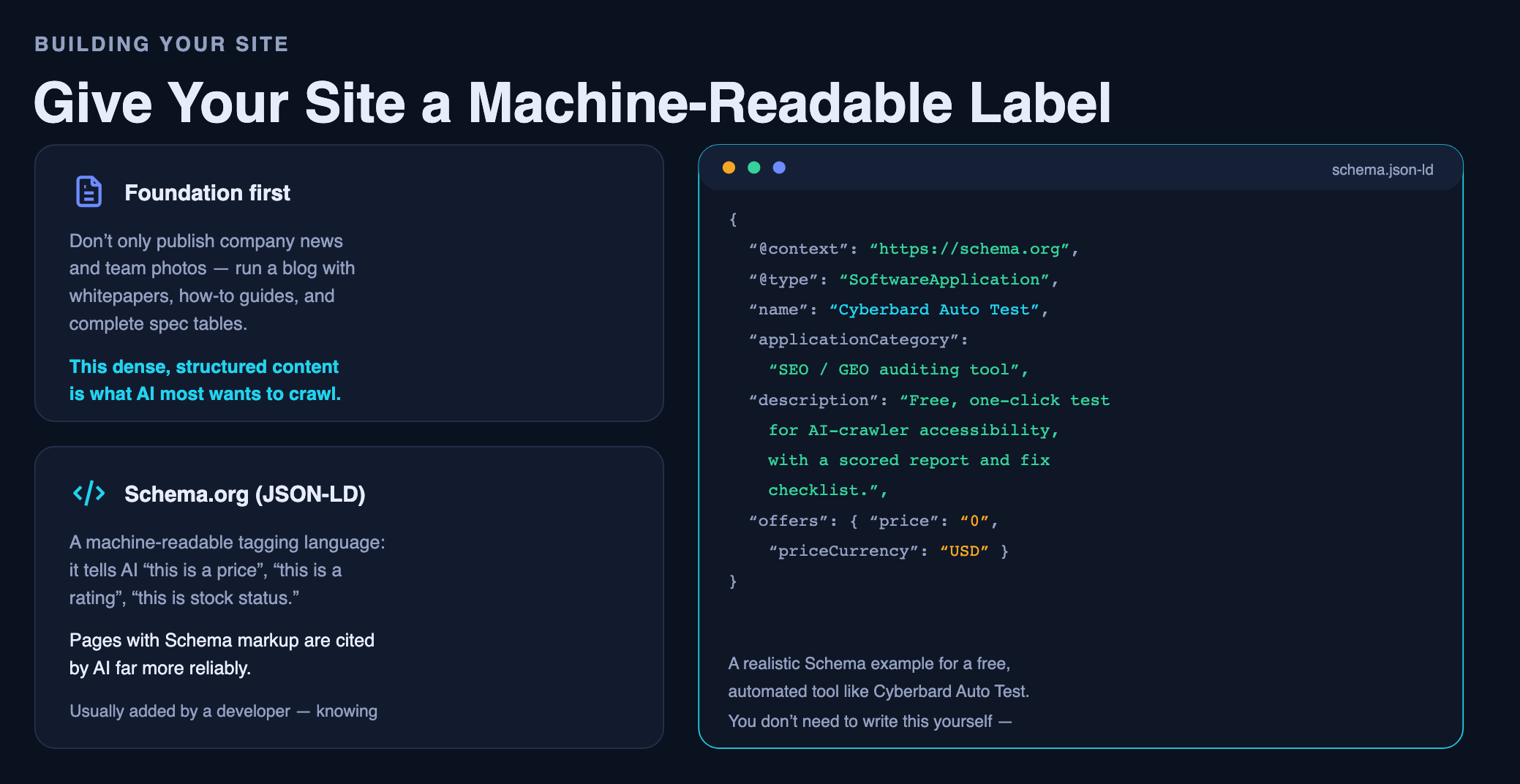
Schema is a shared machine vocabulary — it's like putting a label on every piece of information on a page: this number is a price, this line is a rating, this word is stock status. Pages with proper Schema markup are cited by AI far more often.
Schema lives in your page code. Here are the three most common types.
1. Product — tells AI the price, rating, and availability:
2. Article — tells AI this is a genuine article, who wrote it, and when it was published:
3. LocalBusiness — tells AI a company's address and phone number, useful if you have a physical presence. The structure is similar to the above: swap the type to LocalBusiness and fill in address and phone.
This step is usually implemented by a developer, but knowing what to add — and why — means you won't get talked out of doing it properly.
5.3 Open the Front Door for AI
Many websites block crawlers by default. Check your robots.txt file — it's essentially the guest list at your site's front door, deciding who's allowed in.
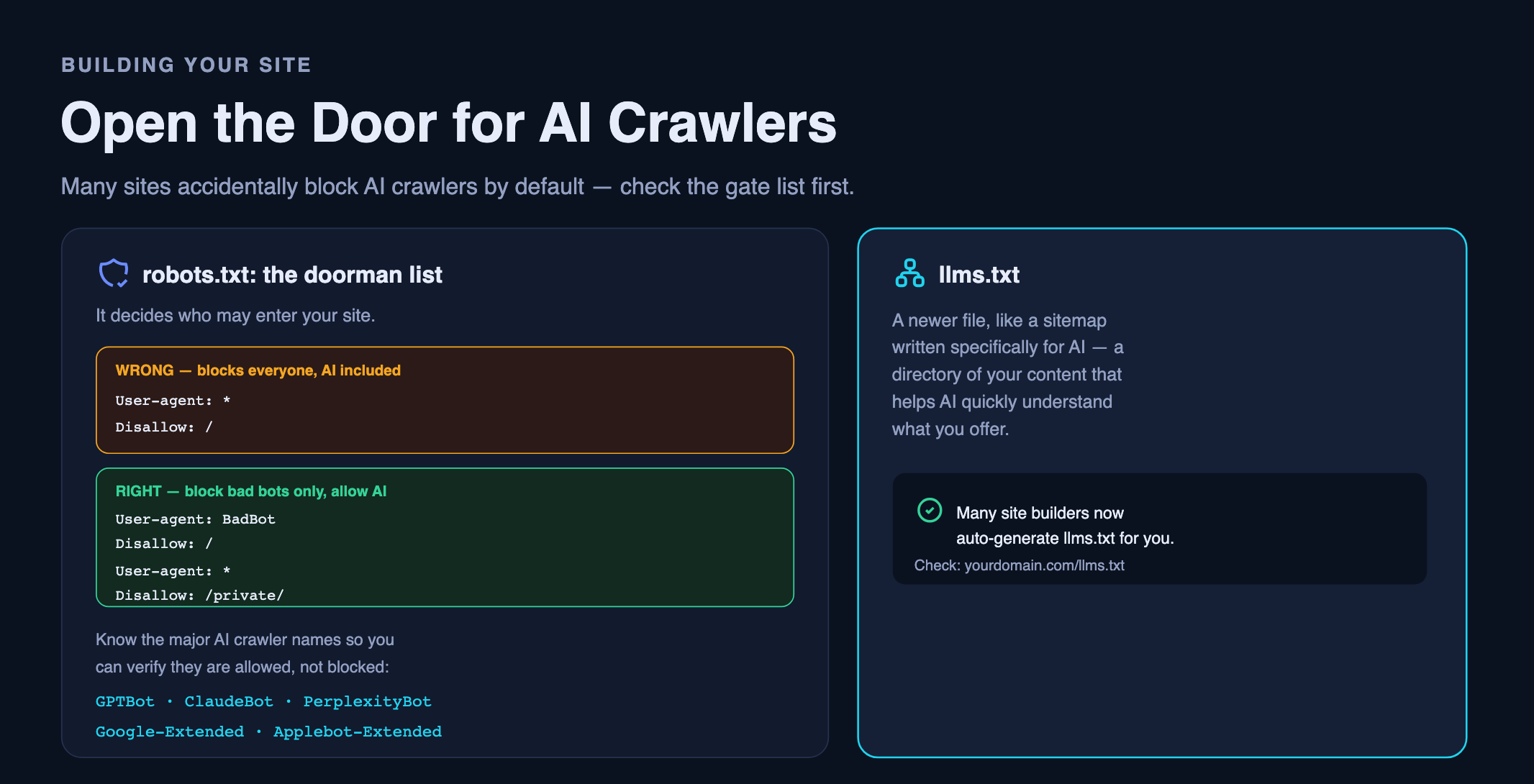
For GEO, never lock AI crawlers out. Know the names of the major AI crawlers: GPTBot (OpenAI), ClaudeBot (Anthropic), PerplexityBot (Perplexity), and Google-Extended (Google's AI training crawler).
This configuration is wrong — it blocks every crawler, AI included:
The correct approach is to block only the crawlers you actually want to block, and let AI through:
5.4 Hand AI a Table of Contents: llms.txt
There's a newer file called llms.txt — it plays a role similar to a traditional XML sitemap, but it's written specifically for AI. It's essentially a table of contents for your site, handed directly to AI so it can quickly understand what content you have.
Many site builders now generate llms.txt automatically — you may not need to configure it by hand. Try appending /llms.txt to your domain to check whether one already exists.
Many people believe that llms.txt is useless, but since it doesn't do any harm either, a lot of folks still recommend adding it. After all, chaos is opportunity, right?
5.5 Two Small Writing Habits Worth Adopting
Two habits, easy to apply whenever you write documentation or a landing page, that meaningfully help AI crawlability.
Answer-first. In every section, put the most important information first. Users asking AI want a direct answer — don't spend three paragraphs building up to the point.
Phrase headings as questions. Write subheadings the way a real user would actually ask, not as abstract nouns — because AI matches user questions against your headings.
- Weaker: "Meeting Notes Feature Overview"
- Better: "How Does Cyberbard's Auto Test Check AI Crawler Access?"
Neither habit costs anything extra — they're purely a matter of phrasing — but they meaningfully raise your odds of being cited.
Chapter 6 — Content Strategy: What to Publish and How to Find Topics
You now know how to write and how to lay the technical groundwork. This chapter covers two things: what types of pages to publish, and how to find the right topics.
6.1 The Three Page Types Worth Prioritizing
In AI search, users tend to ask three categories of questions — build pages that match each one. For a product like Cyberbard, that means three page groups:
- A comparison/roundup page — e.g., "Best AI-Visibility Testing Tools in 2026"
- A feature/landing page — e.g., "How to Check If GPTBot Can Crawl Your Site"
- A how-to/tutorial page — e.g., "How to Fix AI Crawler Access Issues Without a Developer"
6.2 Finding Topics: Watch the Autocomplete
Don't guess at topics. What you assume users care about (your product philosophy) is often not what they're actually searching for.
The simplest, most reliable method: watch the search-box autocomplete. Open Google (or whatever platform your audience uses), type your core industry keyword, and — before hitting enter — look at what the dropdown suggests.
These suggestions come from massive volumes of real user searches, and they closely mirror what AI is most often asked. Answering these questions is how you capture the most precisely targeted traffic.
Example: type "AI visibility test," and the dropdown suggests "AI visibility test free" and "can ChatGPT read my website." Now you know exactly what to write about: free access, and crawler readability.
6.3 Mentioning Your Brand the Right Way
Two rules when weaving your brand into content.
First, no hard-sell — let it emerge from the logic. Explain the problem and the general solution first, then naturally bring in your product. For example: explain why AI crawler access is hard to diagnose, then say "Cyberbard's Auto Test, for instance, checks this automatically by simulating GPTBot, ClaudeBot, and PerplexityBot requests..."
Second, keep keyword density restrained. Don't stuff keywords the way old-school SEO did — modern AI isn't fooled by that. Aim for your brand name to appear naturally once at the start (definition), once in the middle (a list), and once at the end (a conclusion) — roughly three times across a full article. That's enough for AI to remember you without reading as spam.
There's also a more aggressive tactic called programmatic GEO — using templates plus data to mass-generate thousands of long-tail pages covering countless narrow search queries. It can work, but it's an advanced, higher-risk tactic and worth approaching cautiously, since search engines and AI platforms increasingly penalize low-quality, templated content at scale.
Chapter 7 — How to Tell If AI Is Actually Recommending You
Publishing content is only the start. GEO isn't like running a blog with visible view counts and likes — you can't see your "reach" directly. The only reliable method is to simulate a real user and ask AI yourself, and see whether your name comes out. This is the single most important step in the whole process.
7.1 A Three-Step Manual Test
Three to seven days after publishing, start testing. Take the real user questions you've collected and ask them, one by one, to ChatGPT, Perplexity, and other AI assistants — in three escalating steps.
- Check indexing (does AI know you exist?) Ask directly: "Tell me about Cyberbard." If AI can accurately describe what you do, it has indexed you.
- Check recommendation (does AI endorse you?) Ask a generic, brand-free industry question: "Recommend some tools for testing whether my website is visible to AI search engines." See whether you appear in the answer.
- Check citation sources. Notice which pages the AI's answer draws from — this is the single most valuable piece of information you can gather from this whole exercise.
7.2 What to Do If You're Not Being Recommended
If AI recommends a competitor instead, you have two counter-moves.
Move 1 — Write a comparison piece. Since AI already favors that competitor, write a direct comparison between you and them, using the Chapter 4 comparison-table template, highlighting your actual strengths. Next time AI retrieves content about that competitor or category, your comparison page is likely to surface — and AI may end up saying something like "While [competitor] is solid, if AI crawler access is your priority, Cyberbard's free Auto Test might be a better fit." Once you're in the same frame as the leader, you've already won half the battle.
Move 2 — Target a narrower niche. Broad terms are too competitive. If you can't win "AI visibility tool," focus on something narrower, like "free GPTBot access checker for small business websites." Winning the small pond as the clear #1 beats losing the big one — and the most relevant match tends to get the recommendation.
7.3 Watch Three Core Metrics
Don't just test for fun — track three metrics, since they determine your next move.
| Metric | What it tells you | How to act on it |
|---|---|---|
| Indexed rate — % of AI tools that can accurately describe you when asked directly | Whether AI has discovered and correctly understood you at all | If low, the problem is crawlability or content clarity — revisit Chapters 3 and 5 |
| Recommendation rate — % of generic, brand-free queries where you show up unprompted | Whether AI trusts you enough to recommend you over competitors | If low but indexed rate is high, the problem is credibility — add data, citations, comparison content |
| Citation source — which specific pages AI is pulling from when it mentions you | Which of your pages are actually working, so you can produce more like them | Double down on the page format and topic that's already getting cited |
If you're monitoring a large number of queries, automated monitoring tools can replace manual checking; the underlying method is identical, just executed by software instead of by hand.
This chapter's core message: GEO is an ongoing, competitive process — monitoring can never fully stop. If you pause maintenance, competitors will fill the content gap and take your spot in the AI's answer. For competitive industries, check weekly, and patch immediately if you notice a drop.
Chapter 8 — Pitfalls to Avoid, and What's Coming Next
8.1 Three Lines You Cannot Cross
People who did SEO the old way are used to gaming the system — that doesn't work for GEO. AI's screening is stricter than a search engine's: it reads raw code and semantics directly. Cross these lines and, at best, you lose ranking weight; at worst, you get permanently excluded.
| Red line | What it looks like | Consequence |
|---|---|---|
| Hidden keyword stuffing | White-on-white text to hide keywords from users but not machines | AI reads the raw source code, spots it instantly, and flags you for manipulation |
| Fabricated data | Invented market-share numbers or awards | Fails cross-verification, gets tagged low-credibility — even your truthful claims stop being cited |
| Too little information → hallucination | Almost nothing about you online | AI fills the gap itself, sometimes attaching a competitor's negative reputation to you by mistake |
The fix for the third one: maintain at least one accurate, official description of yourself on your own site and major channels.
8.2 Opportunities Worth Getting Ahead Of
Multimodal GEO. AI is moving from reading text to interpreting images too. Starting now, name your site's images properly (not random strings of characters) and add descriptive alt text — this becomes AI's signpost when it starts searching by image.
Personal brand / founder authority. AI is increasingly willing to give more weight to a specific, named person than to a faceless company. Put your founder or technical lead front and center — reinforce "[Name] believes..." in your expert articles. Once AI recognizes that person as an authority in the space, everything attributed to them carries more weight.
Closing Thoughts
The core logic of GEO fits in one sentence: translate your product into a language machines can index, so users can actually find you.
The GEO space isn't crowded yet. Move now, and you can still capture an early advantage. Wait until your competitors are fully indexed by AI, and the cost of breaking in later rises exponentially. Start now.
Want to check where your own site stands today? Search Cyberbard and run the free Auto Test — it tells you, in minutes, whether ChatGPT, Perplexity, and other AI systems can actually read and understand your site, and exactly what's blocking them.